RAG vs Fine-Tuning for Business AI: Which Approach Is Right?
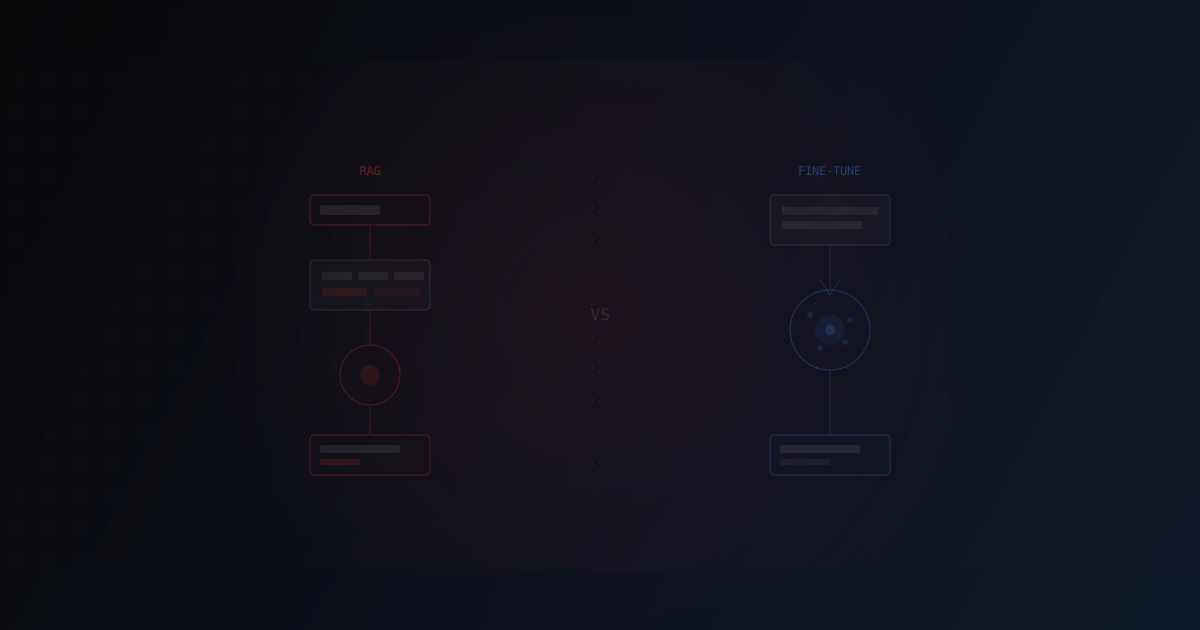
If you are building AI into your business workflows, you will inevitably face this decision: should you use retrieval-augmented generation (RAG) or fine-tune a model on your data? The answer depends on your use case, but for most enterprise applications, the choice is clearer than vendors make it seem.
How Each Approach Works
Retrieval-Augmented Generation (RAG)
RAG keeps the base language model unchanged. When a user asks a question, the system first retrieves relevant documents from your knowledge base, then feeds those documents to the model as context alongside the question. The model generates an answer based on the retrieved information.
Think of it as giving the AI a reference library. It does not memorize your data — it looks things up every time.
Fine-Tuning
Fine-tuning modifies the model itself by training it on your data. The model's weights are updated to incorporate your domain knowledge, terminology, and patterns. After fine-tuning, the model generates answers from its modified parameters without needing to retrieve external documents.
Think of it as teaching the AI your domain until it has internalized the knowledge.
The Practical Tradeoffs
Data Freshness
RAG wins. When your knowledge base changes — new policies, updated documentation, recent decisions — RAG picks up the changes immediately. Fine-tuned models require retraining to incorporate new information, which takes time and compute resources.
For any business where information changes frequently (which is nearly every business), this is often the deciding factor.
Accuracy and Traceability
RAG wins. Every answer can be traced back to specific source documents. Users can verify claims. This is critical in enterprise settings where trust and compliance matter.
Fine-tuned models generate answers from learned patterns, making it difficult to trace where a specific answer came from or verify its accuracy.
Response Latency
Fine-tuning wins. RAG requires a retrieval step before generation, adding latency. Fine-tuned models generate responses directly. For applications where milliseconds matter — real-time customer interactions, high-frequency automation — this gap can be significant.
Cost at Scale
It depends. RAG requires maintaining a retrieval infrastructure (vector databases, embedding pipelines, document processing). Fine-tuning requires periodic retraining runs. At low query volumes, RAG's infrastructure cost may be higher. At high volumes with stable data, fine-tuning can be more economical.
Hallucination Risk
RAG wins. Since RAG grounds responses in retrieved documents, the model is less likely to fabricate information. Fine-tuned models can still hallucinate — they just do it with domain-appropriate vocabulary, which makes hallucinations harder to catch.
For more on how we handle this, read Building AI Agents That Don't Hallucinate.
Domain Adaptation
Fine-tuning wins for specialized language. If your domain uses highly technical terminology, unusual document formats, or requires specific response styles, fine-tuning teaches the model these patterns more naturally than RAG's prompt engineering.
When to Use Each
Choose RAG when:
- Your data changes frequently (weekly or more)
- Accuracy and source attribution are non-negotiable
- You need to respect data access permissions (RAG can filter by user role)
- You want to deploy quickly without training infrastructure
- Multiple data sources need to be queried dynamically
Choose fine-tuning when:
- Your domain has stable, specialized terminology
- Response latency is critical
- You need consistent response formatting or style
- The knowledge base is relatively static
- You have the ML engineering resources to manage training pipelines
Consider both when:
- You need domain-adapted language (fine-tuning) with current information (RAG)
- High-stakes applications where belt-and-suspenders accuracy is worth the complexity
Our Recommendation for Most Enterprises
Start with RAG. It is faster to deploy, easier to maintain, more transparent, and lower risk. If you later find that response quality or latency requires fine-tuning, you can layer it on top of your RAG infrastructure.
This is the approach behind OMI. RAG-first architecture means your data stays current, answers are always cited, and you can start getting value within days rather than the weeks or months a fine-tuning pipeline requires.
The best architecture is the one that gets accurate answers to your team fastest. For most businesses, that is RAG.