Building AI Agents That Don't Hallucinate
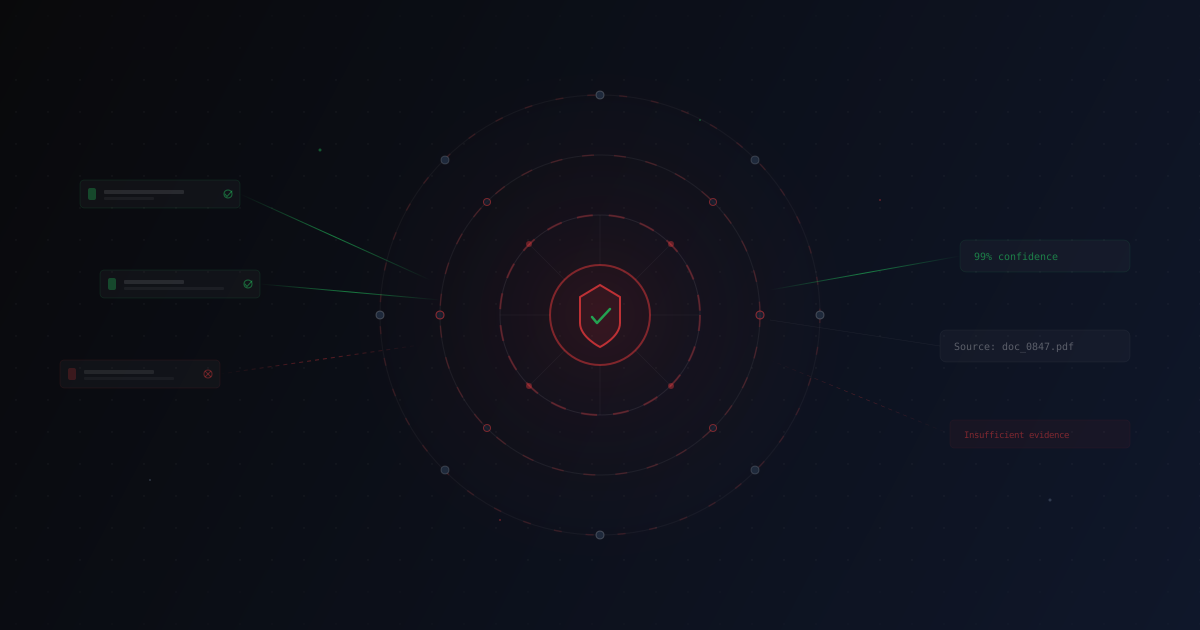
Every company wants an AI assistant that can answer questions from their internal data. Very few trust one enough to actually deploy it. The reason is simple: hallucination.
Why hallucination happens
Large language models are, at their core, pattern completion engines. They predict the most likely next token based on their training data. When asked a factual question about your company's Q3 revenue, they might produce a plausible-sounding number that has no basis in reality.
This isn't a bug — it's how the technology fundamentally works. The challenge is building systems on top of these models that constrain their output to verified facts.
The RAG approach and its limits
Retrieval-Augmented Generation (RAG) is the most common approach to grounding AI responses in real data. The system retrieves relevant documents, passes them as context to the language model, and asks it to generate an answer based on that context.
RAG helps, but it doesn't solve the problem completely. Common failure modes include:
- Context window overflow: When too many documents are retrieved, the model may ignore or misinterpret relevant sections
- Semantic drift: The model may start with retrieved facts but gradually drift into generated content
- Confidence without evidence: The model presents uncertain information with the same confidence as verified facts
How OMI approaches accuracy differently
OMI uses a multi-layered verification architecture that goes beyond standard RAG:
Source attribution: Every answer includes citations to the specific documents and data points it's based on. If the system can't point to a source, it doesn't generate an answer.
Confidence scoring: Rather than presenting all responses equally, OMI assigns confidence scores based on the quality and relevance of retrieved evidence. Low-confidence answers are flagged explicitly.
Query decomposition: Complex questions are broken down into sub-queries, each verified independently against the data. This prevents the semantic drift that occurs when models try to answer compound questions in a single pass.
Refusal when uncertain: This is perhaps the most important design decision. OMI is designed to say "I don't have enough information to answer that" rather than fabricate a response. In practice, this is what makes it trustworthy for business-critical decisions.
The trust equation
Accuracy isn't just a technical metric — it's a trust metric. A system that's right 95% of the time sounds impressive until you realize that 1 in 20 answers might be fabricated. For financial reporting, compliance questions, or operational decisions, that failure rate is unacceptable.
At 99% accuracy with explicit uncertainty flagging, OMI crosses the threshold where businesses can rely on it for daily operations. Not because it's perfect, but because it knows when it's not sure.
Practical implications
The impact of reliable AI agents extends beyond convenience. When teams trust their AI tools, they use them. When they use them, they make faster decisions. When they make faster decisions, the entire organization moves at a different speed.
That's the real promise of non-hallucinating AI — not just accurate answers, but an organization that acts on data instead of waiting for reports.