AI Agents vs Chatbots: What Your Business Actually Needs
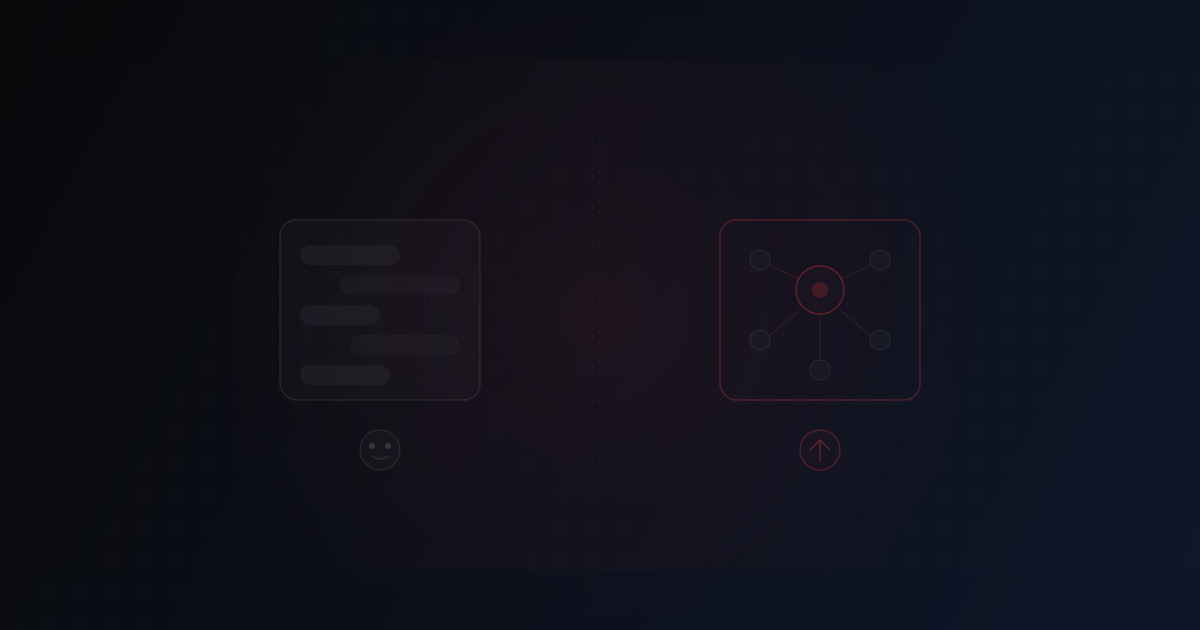
Every enterprise software vendor is now selling "AI agents." But most of what is being marketed as an agent is really just a chatbot with better language skills. Understanding the difference is critical before you invest.
What Chatbots Actually Do
Traditional chatbots — even the ones powered by large language models — follow a simple loop: receive input, generate output. They are conversational interfaces. You ask a question, they give an answer.
The limitations become obvious in enterprise settings:
- No memory across sessions — every conversation starts from zero
- No access to your data — they generate answers from training data, not your company's knowledge
- No ability to take action — they can tell you what to do, but they cannot do it
- No verification — they sound confident whether they are right or wrong
A chatbot can summarize a document you paste into it. But it cannot go find the right document, cross-reference it with three other sources, verify the answer, and cite its sources. That is what an agent does.
What AI Agents Do Differently
An AI agent is a system that can reason, retrieve, act, and verify. The key differences:
Retrieval
Agents connect to your data sources — databases, document stores, APIs, knowledge bases — and pull relevant information in real time. They do not guess from training data.
Reasoning
Agents break complex questions into steps. "What was our fuel shrinkage rate last quarter compared to industry average?" requires retrieving internal data, finding external benchmarks, computing the comparison, and presenting it clearly.
Action
Agents can trigger workflows — generating reports, sending alerts, updating records, or escalating issues to humans when confidence is low.
Verification
The best agents cite their sources. Every claim is traceable to a specific document, database record, or API response. If the agent cannot find supporting evidence, it says so instead of fabricating an answer.
Why This Matters for Your Business
The chatbot vs agent distinction is not academic. It directly affects:
- Trust — employees will not adopt a tool that gives wrong answers, no matter how fluent it sounds
- ROI — agents that connect to your data and take actions save real time; chatbots that only answer questions provide marginal value
- Security — agents with proper retrieval architectures keep your data in your infrastructure; fine-tuned chatbots bake your data into model weights
How OMI Approaches This
OMI is built as a true AI agent platform, not a chatbot wrapper. Here is what that means in practice:
- Retrieval-augmented generation connects OMI to your existing knowledge bases, documents, and data sources
- Source citations on every response let users verify accuracy instantly
- Hallucination guardrails ensure the agent acknowledges uncertainty rather than fabricating answers
- Enterprise-grade security keeps your data within your infrastructure
For a technical deep dive on how we prevent hallucinations, read Building AI Agents That Don't Hallucinate.
The Bottom Line
If you need a conversational FAQ interface, a chatbot is fine. If you need an AI system that can reason over your company's data, take actions, and be trusted by your team — you need an agent.
The question is not "should we use AI?" It is "are we building on the right foundation?" Starting with a chatbot and hoping to upgrade to an agent later rarely works. The architectures are fundamentally different.
Choose accordingly.