Real-Time Analytics in Fuel Retail: Why Delayed Data Costs You Money
In fuel retail, timing is everything. A tank running dry during evening rush hour means lost sales you will never recover. A delivery discrepancy discovered a week later means the evidence trail has gone cold. A pricing decision based on yesterday's data means competing on stale information.
Real-time analytics close these gaps.
The Cost of Delayed Information
Consider what happens at a typical fuel station operating on end-of-day or weekly reporting:
Monday: A slow tank leak begins, losing 30 liters per day. Tuesday-Thursday: The leak continues undetected. Staff notices nothing unusual during daily operations. Friday: Weekly reconciliation reveals a 150-liter discrepancy. Management investigates. Following Monday: The leak is located and repair is scheduled.
Total loss: 200+ liters over 7 days, plus repair costs, plus the investigation time.
With real-time monitoring, the same scenario:
Monday: Tank-level sensors detect an anomalous 30-liter drop overnight with no corresponding sales. An alert fires immediately. Monday afternoon: The leak is identified and addressed.
Total loss: 30 liters. One day versus one week. The math is straightforward.
What Real-Time Analytics Look Like in Practice
Live Operational Dashboard
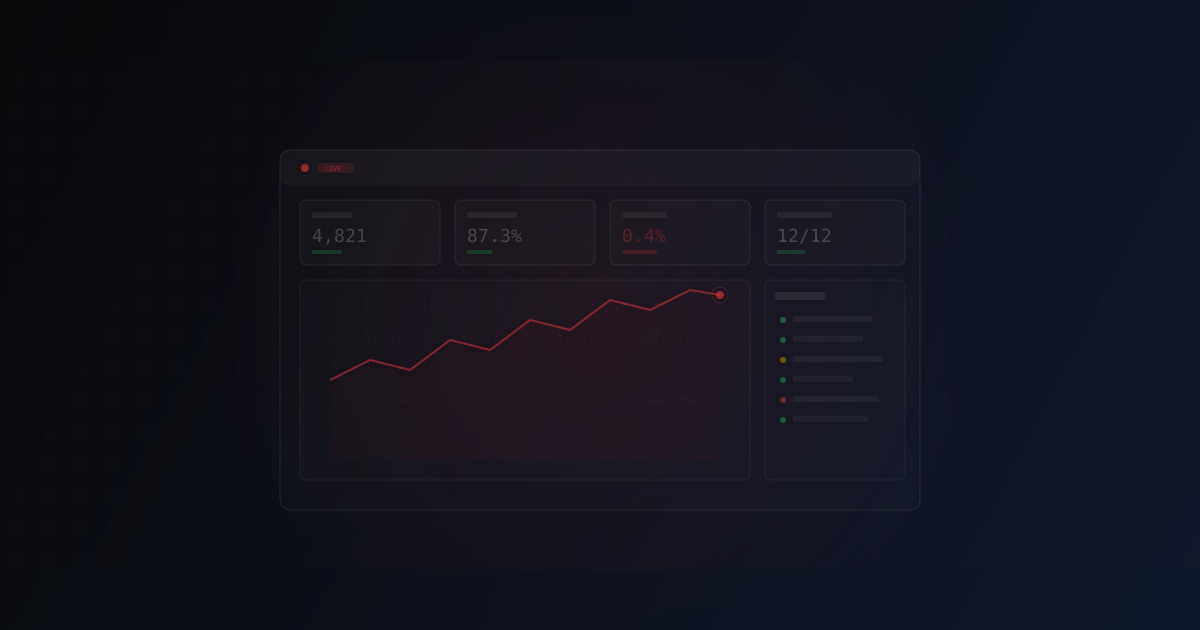
Every station, every tank, every dispenser — visible in one view, updating continuously. Petro-Astra provides this unified view across your entire network, whether you operate 3 stations or 300.
Key metrics that demand real-time visibility:
- Tank levels and projected time-to-empty
- Active transactions and throughput rates
- Shift performance versus targets
- Delivery status and ETA tracking
Instant Anomaly Alerts
Rule-based and AI-powered alerts that fire the moment something deviates from expected patterns:
- Shrinkage alerts — unexplained tank level drops
- Transaction anomalies — unusual sale patterns, voided transactions, off-hours activity
- Equipment alerts — dispenser errors, flow rate deviations, calibration drift
- Delivery alerts — volume discrepancies between BOL and actual receipt
The key word is "instant." An alert that arrives 24 hours after the event is a report, not an alert.
Dynamic Demand Forecasting
Real-time sales data feeds into demand models that update continuously:
- Current draw rates projected against remaining inventory
- Automatic reorder triggers based on actual consumption, not static thresholds
- Delivery scheduling optimized for current demand patterns
- Stockout probability calculated in real time
Live Margin Tracking
Know your margin position at every moment:
- Cost-of-goods updates when new deliveries arrive at different prices
- Per-transaction margin visibility
- Product mix analysis updated with every sale
- Competitive pricing data integrated with your operational metrics
From Monitoring to Action
Real-time data is only valuable if it drives real-time decisions. The analytics layer must connect observation to action:
Observation: Station 4 tank levels are dropping faster than forecast. Analysis: A local event is driving 40% higher traffic than normal. Action: Emergency delivery is triggered to prevent stockout during peak demand.
Observation: Dispenser 3 at Station 7 shows declining flow rates over the past 48 hours. Analysis: Historical patterns indicate a filter clog or pump wear. Action: Maintenance ticket is created and technician dispatched before the dispenser fails.
Observation: Shrinkage rate at Station 2 spikes during specific shifts. Analysis: Pattern correlates with a particular shift crew, not equipment issues. Action: Targeted audit and investigation focused on the right people and time period.
Implementation Realities
You Do Not Need to Start From Scratch
Most stations already have ATG systems and digital dispensers generating data. The challenge is not generating data — it is aggregating, processing, and presenting it in real time.
Petro-Astra connects to your existing hardware infrastructure and layers real-time analytics on top. No forklift upgrade required.
Bandwidth and Latency
Real-time does not mean every millisecond. For fuel retail operations, data freshness measured in minutes is sufficient for most use cases. Tank-level updates every 5 minutes, transaction data synced after each sale, and alerts processed within 60 seconds covers the vast majority of operational needs.
This is achievable even on the connectivity infrastructure available at most Indian fuel stations.
Change Management
Moving from weekly reports to real-time dashboards changes how people work. Station managers who are used to reviewing data in batches need to learn to monitor continuously and respond to alerts promptly.
Start by using real-time data to validate what weekly reports were already telling you. Once the team trusts the real-time data, shift decision-making to be driven by it.
The Bottom Line
Every hour between when something happens and when you know about it is a cost — in lost fuel, lost sales, lost margin, or lost time. Real-time analytics do not just reduce that gap. They eliminate it.
The question is not whether you can afford real-time analytics. It is whether you can afford to keep making decisions on data that is hours or days old.