Fuel Station Inventory Management: 7 Best Practices That Cut Losses
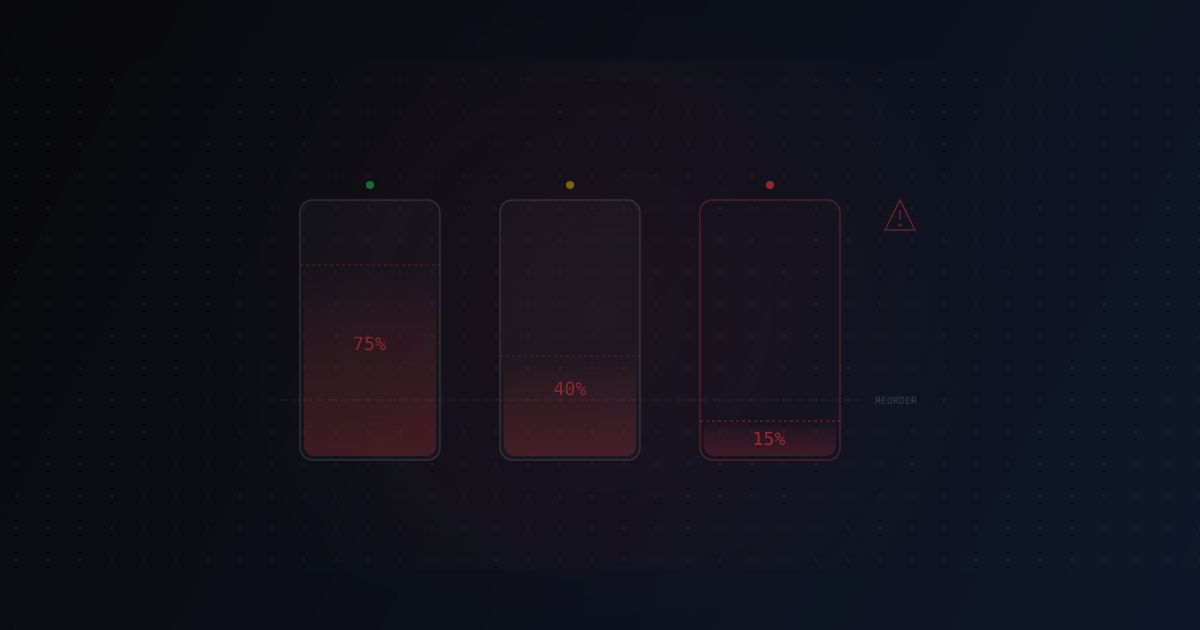
Inventory management at a fuel station is deceptively complex. You are managing a volatile, high-value liquid commodity that evaporates, expands with temperature, and can disappear through dozens of failure points between delivery and sale.
Here are seven practices that separate well-run stations from those bleeding margin every day.
1. Automate Tank Level Monitoring
Manual dip-stick readings are inaccurate, infrequent, and labor-intensive. A single missed reading can mean running dry during peak hours — or worse, not detecting a leak for days.
Automated tank gauging systems provide continuous, accurate level data. When connected to a centralized platform like Petro-Astra, you get real-time visibility across every tank at every location, with alerts before problems become emergencies.
2. Track Shrinkage at Every Point
Fuel shrinkage — the difference between what you buy and what you sell — typically ranges from 0.5% to 2% of throughput. At scale, even small percentages translate to lakhs in lost revenue annually.
Break shrinkage tracking into three segments:
- Delivery losses — compare BOL (bill of lading) quantities against tank level changes at delivery
- Storage losses — monitor tank levels between deliveries for unexplained drops
- Dispensing losses — reconcile meter readings against tank drawdowns
Each segment has different causes and different solutions. You cannot fix what you do not measure.
3. Implement Temperature-Compensated Accounting
Fuel volume changes with temperature — roughly 0.06% per degree Celsius for petrol. If you are buying fuel on a hot afternoon and selling on a cool morning, you could be losing money on pure physics.
Temperature-compensated volume tracking adjusts all measurements to a standard reference temperature, giving you accurate book-to-physical reconciliation regardless of ambient conditions.
4. Set Dynamic Reorder Points
Static reorder points ("order when tank drops below 30%") ignore demand variability. A 30% tank on a slow Tuesday is very different from 30% on a Friday before a holiday weekend.
Use historical sales data and demand patterns to set dynamic reorder points that account for:
- Day of week and time of year
- Local events and holidays
- Weather forecasts (rain reduces traffic, heat increases consumption)
- Supplier lead times
5. Reconcile Daily, Not Weekly
Weekly reconciliation means you discover problems five to seven days too late. Daily book-to-physical reconciliation catches discrepancies when they are still small and traceable.
This does not have to be manual. Automated reconciliation through Petro-Astra compares sales data, delivery records, and tank levels continuously — flagging variances that exceed configurable thresholds the moment they occur.
6. Audit Your Dispensers Regularly
Dispensers drift out of calibration over time. A dispenser that over-delivers by just 0.3% across thousands of daily transactions adds up to significant losses.
Establish a monthly calibration check schedule and track dispenser accuracy over time. Patterns in calibration drift can indicate mechanical wear that needs proactive maintenance rather than reactive repair.
7. Centralize Visibility Across Locations
If you operate multiple stations, the single biggest operational upgrade is centralizing your inventory data into one view. Comparing performance across locations reveals:
- Which stations have abnormally high shrinkage
- Where demand forecasting is consistently off
- Which suppliers deliver the most accurate quantities
- Where equipment maintenance is overdue
Managing each station as an island guarantees that you miss these patterns.
The Compound Effect
None of these practices is revolutionary on its own. But implemented together, they compound. Stations that adopt automated monitoring, daily reconciliation, and centralized analytics typically see shrinkage reductions of 30-50% within the first year.
That is not a marginal improvement. For a high-throughput station, it can mean the difference between healthy margins and slow decline.