AI Agents for Enterprise Data: Unlocking Your Company's Hidden Knowledge
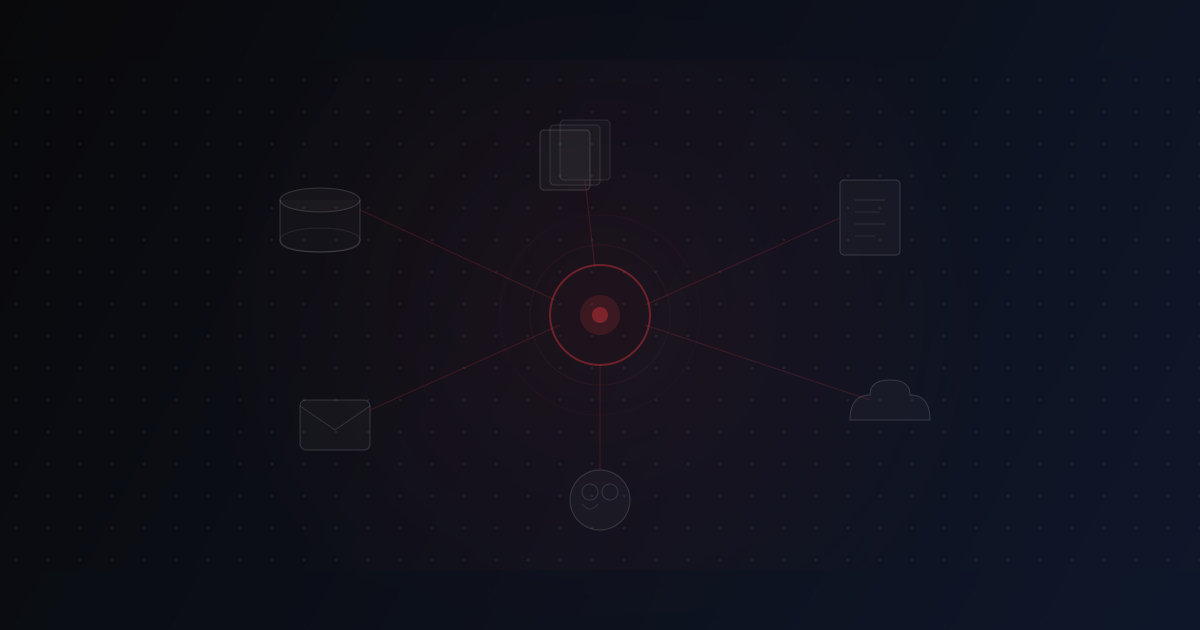
Every enterprise sits on a goldmine of institutional knowledge. The problem is that it is buried across dozens of systems — wikis, shared drives, Slack threads, email chains, CRM notes, support tickets, and the heads of long-tenured employees.
AI agents are the first technology that can actually make this knowledge accessible at scale.
The Enterprise Knowledge Problem
Consider what happens when a new employee asks a seemingly simple question: "What is our refund policy for enterprise clients?"
The answer might exist in:
- A policy document on SharePoint (last updated 18 months ago)
- A Slack thread where the VP of Sales clarified an exception (3 months ago)
- A support ticket where the policy was applied differently (last week)
- An email from Legal with updated compliance requirements (2 weeks ago)
No single source has the complete, current answer. A traditional search returns all of these results and leaves the employee to synthesize them. An AI agent does the synthesis.
How Enterprise AI Agents Work
A well-built enterprise AI agent operates in four stages:
1. Connect
The agent integrates with your existing data sources through APIs, connectors, and document ingestion pipelines. Your data stays where it lives — the agent reaches into it as needed.
2. Retrieve
When a user asks a question, the agent identifies which sources are most likely to contain relevant information and retrieves the specific passages or records that matter.
3. Reason
The agent synthesizes information from multiple sources, resolves contradictions (flagging them when necessary), and constructs a coherent answer.
4. Cite
Every claim in the response is linked back to its source — the specific document, message, or record. Users can verify the answer in one click.
This is the architecture behind OMI. Rather than training a model on your data (which creates staleness and security concerns), OMI retrieves from your live data sources every time a question is asked.
Use Cases That Deliver Immediate ROI
Internal Knowledge Management
Employees spend an average of 1.8 hours per day searching for information. An AI agent that can answer questions about policies, procedures, and past decisions — with citations — can reclaim a significant portion of that time.
Customer Support Acceleration
Support agents handling complex tickets often need to search multiple knowledge bases, past tickets, and product documentation. An AI agent pre-fetches relevant context and presents it alongside the ticket.
Compliance and Audit Preparation
When auditors ask for evidence of a policy or decision, the AI agent can surface the relevant documents, communications, and records in seconds rather than days.
Onboarding
New employees ramp up faster when they can ask questions and get accurate, sourced answers from day one — instead of waiting for colleagues to have time.
What to Look for in an Enterprise AI Agent
Not all solutions labeled "AI agent" deliver the same value. Evaluate based on:
- Data connectivity — how many of your existing systems can it integrate with?
- Citation quality — does it show exactly where each answer came from?
- Hallucination handling — does it admit when it does not know, or does it fabricate?
- Security model — does your data leave your infrastructure?
- Permission awareness — does it respect existing access controls?
These are not nice-to-haves. They are the difference between a tool your team trusts and one they abandon within weeks.
Getting Started
The fastest path to value is starting with a single, well-defined knowledge domain — your internal wiki, your product documentation, or your support knowledge base. Once the agent proves its value in one domain, expand to others.
OMI is designed for exactly this kind of phased deployment. Start with one data source, see results, then connect more as confidence grows.
Your company's knowledge already exists. The question is whether your team can find it when they need it.